What if a simple printable drawing became the starting point for a true work of art?
Welcome to the Mila Pastel art coloring pages collection: original designs you can print for free and interpret however you like. Colored pencils, markers, paint, watercolor, pastels, or mixed media: every illustration can be approached in many different ways.
There’s no need to look for the “perfect” color here. You can draw inspiration from nature, from painting, or from great artists, or simply let your imagination run free.
The same drawing can lead to completely different creations. One illustration can turn out soft and pastel, bright and cheerful, bold and graphic, or become a truly personal little masterpiece.


Free Printable Art Designs
The coloring pages in this collection are, above all, original printable illustrations.
You can use them for a classic coloring session, or as a starting point to experiment with different art techniques.
With colored pencils, you can work on shades and gradients. With markers, you can create bold, bright blocks of color. With paint or watercolor, you can play with transparency, blending, and texture.
And why not try pastels to create a completely different mood?
The printed drawing becomes a space of freedom: you choose the colors, materials, and technique that suit you best.


Color Like an Artist
Coloring isn’t just about filling in shapes.
Choosing colors, contrasts, harmonies, and combinations is a key part of the creative process.
For example, you could choose a palette of three or four colors and stick to it throughout the whole illustration. You could also work only with warm colors, only with cool colors, or with different shades of a single color.
Another idea is to study a painting you love and use it as inspiration to build your own palette.
There’s no need to copy an artist’s colors exactly. The goal is rather to draw inspiration from a mood, a light, or a color harmony.
Find Inspiration in Painting and Art History
Painting is a wonderful source of inspiration for coloring and creative activities.
Impressionism, for example, may inspire you to experiment with light and subtle shades. Claude Monet’s work shows how the same scene can change depending on the time of day, the season, or the light.
Fauvism, with artists like Henri Matisse and André Derain, takes a much bolder approach to color. Colors can be intense and don’t necessarily try to reproduce exactly what we see.
With Cubism, associated with Pablo Picasso and Georges Braque, it’s the shapes, angles, and structure of the image that become the source of inspiration.
Other artists can also fuel your imagination.
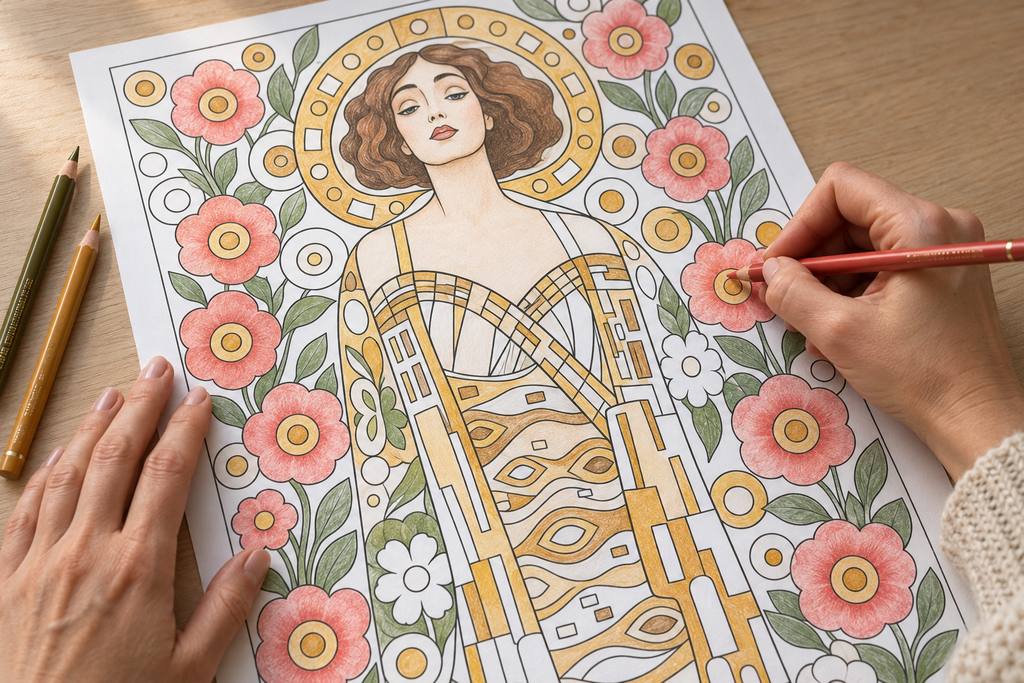
Vincent van Gogh is famous for his expressive colors and deeply personal compositions. Gustav Klimt can inspire you with his decorative patterns and rich compositions. Henri Matisse shows how simple shapes and bold colors can create a highly expressive work.
These artists aren’t models to copy. They can simply encourage you to be more daring with your own colors.
Which Technique Should You Use?
An art coloring page can be approached with many different techniques.
🖍️ Colored Pencils
Colored pencils are especially handy for detailed designs. They let you layer several shades, create gradients, and gradually build up your colors.
Start with a light color, then add several layers to get a deeper shade.
👉 [See our favorite colored pencils]
🎨 Paint
Some designs can also be used as a base for painting.
Gouache gives you opaque, bold colors, while watercolor brings more transparency and lightness.
If you’d like to paint a printed design, choose paper suited to your medium, especially for water-based paints. Mixed media paper or cardstock will hold up much better than regular printer paper.
🖌️ Pastels
Pastels create effects that are very different from traditional coloring.
Whether you choose soft pastels or oil pastels, depending on your paper and technique, they can bring gentle colors, texture, and beautiful blends. Flowers, landscapes, and decorative compositions work especially well with this approach.
✏️ Graphite Pencil
You can also set color aside altogether.
A design can be worked entirely in pencil, playing with shadows, light, and different shades of gray.
This turns a coloring illustration into a real drawing exercise.
🖋️ Markers
Markers let you create bold colors and very graphic compositions.
They’re especially great when you want to play with contrast and solid blocks of color. Alcohol markers, in particular, blend smoothly and give streak-free results.
👉 [See our favorite markers]
How to Find a Beautiful Color Palette
Not sure which colors to choose?
Start by looking around you.
Nature is an especially rich source of inspiration: the colors of a garden, a sunset, a forest, or a bouquet can all be a great starting point.
You can also take inspiration from a photograph, a painting, or simply a color you love.
A few palette ideas:
- pastel tones for a soft, delicate piece;
- blue and green for a fresh, natural feel;
- ochre, orange, and red for a warm atmosphere;
- pink, purple, and blue for a dreamy composition;
- bright, contrasting colors for a bold, graphic result;
- a single color in several shades for an elegant effect.
There’s no need to stay realistic. A tree can be blue, a flower purple, or the sky pink. Artistic coloring truly begins the moment you allow yourself to make your own choices.
A Creative Activity for Adults and Kids
Art designs can be used in many ways.
Kids can discover colors and experiment freely without needing to know how to draw. Adults can use the illustrations to explore different palettes and techniques.
The same design can even be given to several people and lead to completely different results.
That’s one of the most wonderful things about a coloring illustration: everyone starts with the same drawing, but every creation becomes unique.
Free Coloring Pages to Print and Make Your Own
In this collection, you’ll find free printable art coloring pages: illustrations designed to give you plenty of creative freedom.
Choose your design, print it, and grab your pencils, markers, pastels, or paints.
You can follow the lines and simply color, look for inspiration in art history, or completely transform the illustration. There’s no right or wrong way to create.
A coloring page can stay a coloring page. It can also become a painting, a color study, an art exercise, or simply a lovely creative moment.
Explore More Mila Pastel Coloring Collections
Love mixing up styles? Take a look at our other collections:
Travel Coloring Pages
Landscapes, destinations, and travel-inspired scenes to print and color.
Kawaii Coloring Pages
Cute, playful illustrations to color for a world full of sweetness.
Art Therapy Coloring Pages
Detailed patterns and illustrations to take your time coloring, creating, and relaxing.