This post contains affiliate links. As an Amazon Associate, I earn from qualifying purchases, at no extra cost to you.
Choosing the right watercolor pencils for beginners makes all the difference, and I learned that the hard way. The first time I tried them, I colored as usual, brushed a little water over my work, and waited for the magic. Nothing happened, apart from a slightly blurry scribble.
The problem wasn’t my technique. It was the pencil: a bargain set whose pigment was far too weak to create a real watercolor effect.
Since then, I have tested several ranges, from affordable sets to artist-grade collections like the Faber-Castell Albrecht Dürer watercolor pencils.
If you enjoy coloring, you will find my free printable coloring pages useful for trying out different techniques on paper.
Below you’ll find my picks for the best watercolor pencils, how each range differs, how to choose the right set, and easy watercolor pencil techniques to get the most out of the watercolor effect.
Watercolor Pencils vs. Colored Pencils: What’s the Difference?
A regular colored pencil lays down dry pigment. The color stays exactly as it is, even if you brush water over it.
A watercolor pencil, also called a water-soluble colored pencil, contains a water-soluble binder mixed with the pigment. You can color just as you would with a regular pencil, then use a damp brush to turn your strokes into something that looks like watercolor paint. In other words, they work wet or dry.
This gives you a softer, more painterly finish. You can also layer several colors before adding water to create blends and gradients.
There is one important requirement: your paper must be able to handle water. Thin paper may buckle, pill, or let moisture soak through to the next page.
Even with an excellent pencil, the result won’t automatically be perfectly smooth. Light colors usually dissolve easily, while dark or highly pigmented shades may leave visible pencil marks. In that case, several light passes with a damp brush will help.
The Best Watercolor Pencils for Beginners and Beyond
After comparing different ranges, these are the watercolor pencils for adults I would recommend for coloring and illustration.
| Set | Level | Color Intensity | Water Solubility | Best For |
|---|---|---|---|---|
| Faber-Castell Goldfaber Aqua | Beginner | ⭐⭐⭐⭐ | ⭐⭐⭐⭐ | Learning the technique |
| Derwent Watercolour | Beginner / Intermediate | ⭐⭐⭐⭐ | ⭐⭐⭐⭐ | Soft, delicate results |
| Faber-Castell Albrecht Dürer | Intermediate / Advanced | ⭐⭐⭐⭐⭐ | ⭐⭐⭐⭐⭐ | Coloring and illustration |
| Derwent Inktense | Intermediate / Advanced | ⭐⭐⭐⭐⭐ | ⭐⭐⭐⭐⭐ | Bold, vibrant color |
1. Faber-Castell Goldfaber Aqua: Best Watercolor Pencils for Beginners
The Goldfaber Aqua is the first set I recommend to anyone discovering watercolor pencils.
These Faber-Castell watercolor pencils offer good pigmentation, a sturdy core, and forgiving performance while you learn how much water to use.
Their biggest advantage is value for money. There is no need to start with a large professional set just to understand how the technique works.
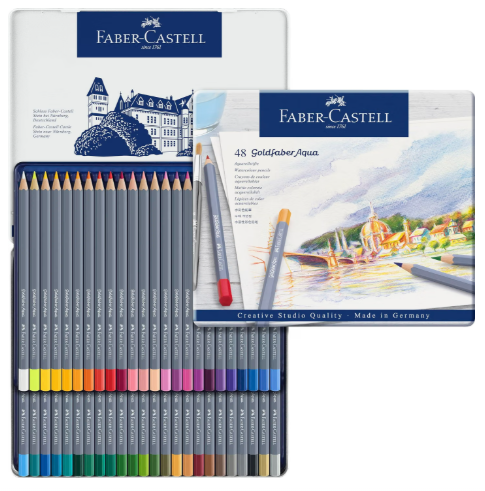
A 24-color set already allows for a wide range of blends.
My pick for beginners: Goldfaber Aqua 24.
2. Derwent Watercolour: Best for Soft, Delicate Results
Derwent watercolor pencils (spelled “Watercolour” by this British brand) are a great choice if you prefer gentle colors and subtle effects.
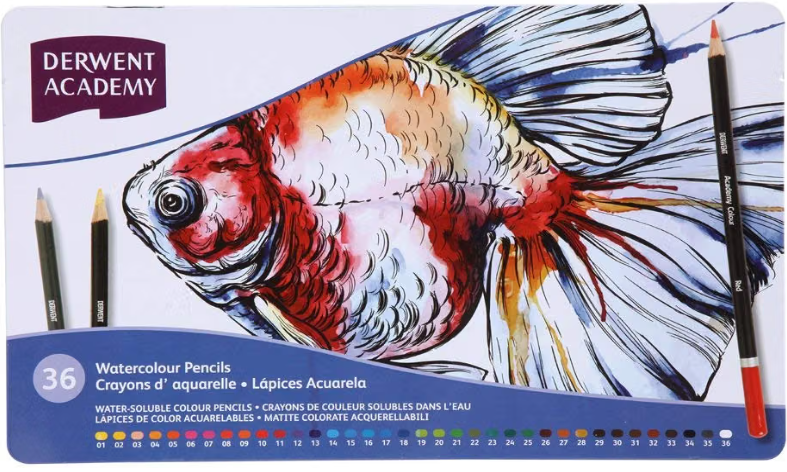
They let you build shades and gradients gradually, which works beautifully for coloring pages where you want a soft atmosphere rather than bold intensity.
I would place this range between beginner and intermediate.
3. Faber-Castell Albrecht Dürer: Best Artist-Grade Upgrade
The Albrecht Dürer pencils are in a different league. Many artists consider them among the best watercolor pencils available.
Their 3.8 mm core glides comfortably across the page, and the pigments are highly water-soluble. Once activated with a damp brush, the colors produce a genuine watercolor look.
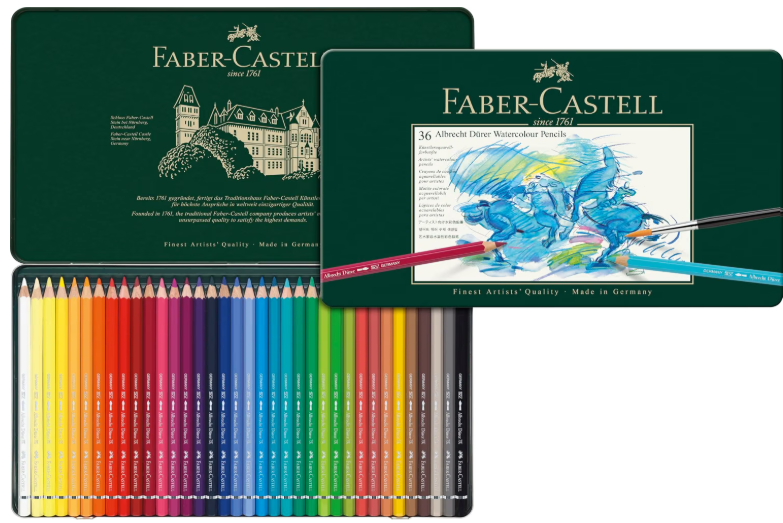
They are especially well suited once you feel comfortable with the technique and want more control over your blends and shading.
The range comes in many sizes, including 12, 24, 36, 60, and 120 pencils.
My pick: the 36-pencil set, which offers a rich palette without jumping straight to a very large collection.
4. Derwent Inktense: Best for Vibrant Color
Derwent Inktense pencils are a special case.
They are extremely pigmented and deliver much bolder color than most traditional watercolor pencils.
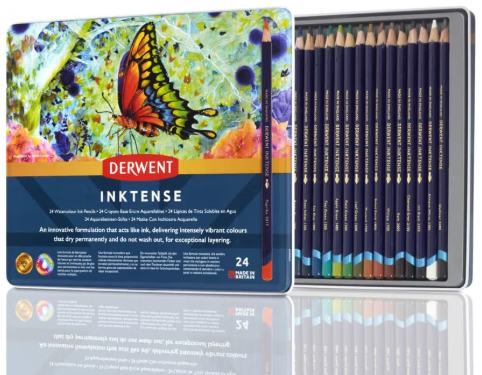
Their key feature is this: once dry, the color becomes permanent. You can work over an area you have already painted without reactivating the layer underneath.
That makes them ideal for layering and building depth.
They can also be used on some fabrics, which expands their use beyond coloring on paper.
My pick to try the range: Inktense 24.
Good to know: Inktense pencils don’t behave exactly like classic watercolor pencils. Their permanence once dry is precisely what makes them so appealing.
You can learn more about each range on the official Faber-Castell and Derwent websites.
Which Watercolor Pencils Should You Choose for Your Level?
If you’re still undecided, here is what I would choose:
To start without a big investment: Faber-Castell Goldfaber Aqua 24.
The easiest way to learn how to color, activate the pigment, and experiment with blending.
For soft colors: Derwent Watercolour 36.
A good option if you value subtlety over intensity.
To step up: Faber-Castell Albrecht Dürer 36.
An excellent choice once you practice regularly and want more richness and precision.
For bold, vibrant color: Derwent Inktense 24.
Ideal if you want strong pigments and like the idea of colors that become permanent once dry.
How Many Colors Do You Need to Start?
Twenty-four colors are plenty to understand how blending works.
Many people buy a 48- or 72-pencil set right away, only to reach for the same shades every time.
In my opinion, 36 colors is the best balance. You get a varied palette without ending up with lots of nearly identical shades.
Larger sets make sense once you practice regularly and start needing very specific shades.
Above all, 12 or 24 quality pencils are better than a huge bargain set. Pigmentation matters even more with this technique: a color that is already pale before water is added will only look weaker once diluted.
Best Paper for Watercolor Pencils
This is one of the most important points.
Standard coloring paper (around 24 to 32 lb, or 90 to 120 gsm) isn’t designed to take much water. It can buckle, pill, and sometimes let moisture seep through to the next sheet.
To really use the watercolor technique, I recommend watercolor paper of at least 90 lb (about 190 gsm).
If you use a lot of water, 140 lb (300 gsm) paper will be even more comfortable to work on.
Hot Press or Cold Press?
Hot-press (smooth) paper works well for coloring pages and fine details.
Cold-press (textured) paper is great for large areas and more painterly effects.
To start, simply look for “watercolor paper” or “mixed media” on the pad.
Don’t overlook this step: even the best watercolor pencil can’t perform well on paper that doesn’t handle water.
Which Brush Should You Use with Watercolor Pencils?
You don’t need a professional painter’s kit.
A soft round brush, size 6 to 10, works for most areas of a coloring page.
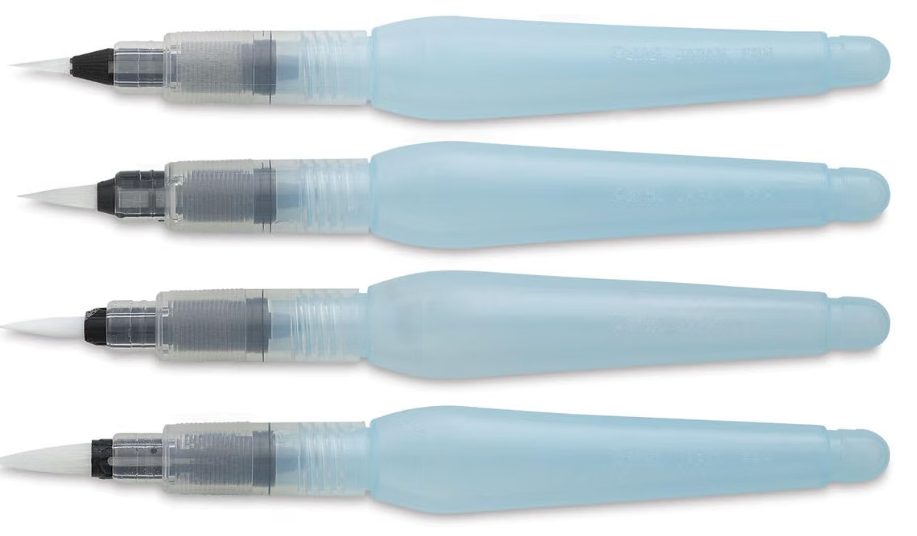
A finer brush, around size 2 to 4, is useful for small details.
A water brush pen is also very convenient. It holds water in its barrel, so you can work without keeping a cup of water beside you. Some watercolor pencil sets even come with a brush included.
Synthetic bristles are perfectly suitable for this use.
How to Use Watercolor Pencils: 3 Easy Techniques for Beginners
You don’t have to simply color and brush over it. Here are three watercolor pencil techniques for beginners.
1. Color First, Then Add Water
This is the simplest method. Color normally on your paper, then run a slightly damp brush over the area. The water gradually dissolves the pigment and turns your pencil strokes into a smoother wash of color.
Start with very little water. It’s much easier to add more than to rescue an area you have soaked.
2. Lift Color Directly from the Pencil Tip
This technique is especially handy for painting small areas. Wet your brush, then touch it directly to the pencil tip to pick up pigment. You can apply that color straight onto the paper, just like a small watercolor palette. The result is much more fluid from the start.
3. Blend Several Colors Before Adding Water
Place two or three colors side by side, then use a damp brush to blend them together. It’s an excellent way to create gradients. For example, place a light blue next to a darker blue, then blend them gradually with your brush. You can also experiment with complementary colors to create more complex shades.
Common Beginner Mistakes to Avoid
Using Too Much Water
This is probably the most common mistake. A soaking-wet brush can push pigment too far and leave blooms (those cauliflower-like marks). Always start with a damp brush rather than a dripping one.
Using Paper That’s Too Thin
Even good technique is hard to control on paper that buckles at the first touch of water.
Pressing Too Hard
The harder you press, the more pigment you lay down, but a very heavy layer can be harder to activate evenly with water. For large areas, several light layers usually work better than one heavy one.
Expecting Perfect Results Right Away
Watercolor pencil art for beginners takes a little getting used to. Before starting a coloring page that matters to you, test on a scrap of the same paper: a light color, a dark color, a two-color blend, and different amounts of water. You’ll quickly understand how your supplies behave.
Not Letting the Paper Dry Properly
When the paper has absorbed a lot of water, let it dry flat. Depending on how much water you used and the paper weight, drying can take about 15 to 30 minutes, or longer for a very wet sheet.
Watercolor Pencils FAQ
What are the best watercolor pencils for adult coloring books?
For most adult coloring books and pages, the Faber-Castell Goldfaber Aqua is a great place to start. If you want richer color and more precision, the Albrecht Dürer range is worth the upgrade. Keep in mind that many coloring books use thin paper, so add only a little water, or color on single-sided pages printed on heavier paper.
Can you use watercolor pencils dry?
Yes. Watercolor pencils can be used wet or dry. Without water, they behave like regular colored pencils, so you can keep some areas dry for texture and contrast.
Can you use any colored pencil with water?
No. Only pencils labeled watercolor or water-soluble contain the binder that lets water transform the pigment. A regular colored pencil won’t give the same result.
Do you need a special brush?
No. A simple soft round brush is perfectly fine to start. Synthetic bristles work well.
Can you mix watercolor pencils and regular colored pencils?
Yes, and it’s a great technique. Use watercolor pencils for backgrounds, large areas, and gradients, then finish details with regular pencils, which stay completely dry. This helps you keep fine details that shouldn’t be affected by water.
How long does the paper take to dry?
It depends on the paper and the amount of water used. A small, lightly dampened area can dry quickly, while a large, very wet surface takes longer. Allow about 15 to 30 minutes for moderate use, but check that the paper is truly dry before adding a new layer.
Why are my pencil strokes still visible after adding water?
This is especially common with dark or highly pigmented colors. The pigment may have been applied too heavily or not activated enough. Try using a sufficiently damp brush and making several light passes rather than soaking the paper all at once.
My Watercolor Pencil Recommendations
For beginners: Faber-Castell Goldfaber Aqua 24
A great entry point, with enough colors to learn blending without investing in a large set.
Amazon – Faber-Castell Goldfaber Aqua, 24 pencils
For a wider palette: Goldfaber Aqua 36
If you already know you’ll use watercolor pencils regularly, the 36-pencil set offers more shades.
Amazon – Faber-Castell Goldfaber Aqua, 36 pencils
To step up: Faber-Castell Albrecht Dürer 36
My choice for regular practice, especially detailed coloring and illustration.
Amazon – Faber-Castell Albrecht Dürer, 36 pencils
For even more shades: Albrecht Dürer 60
If you already love this range and want a fuller palette, the 60-pencil set offers a much wider choice.
Amazon – Faber-Castell Albrecht Dürer, 60 pencils
For soft tones: Derwent Watercolour 36
A lovely option if you’re after subtle, delicate results.
Amazon – Derwent Watercolour, 36 pencils
For vibrant color: Derwent Inktense 24
Choose these for strong pigmentation and colors that become permanent once dry.
Amazon – Derwent Inktense, 24 pencils
For the full Inktense palette: 72 colors
If you practice regularly and want a very wide range of shades, the 72-pencil set is the most complete option in this guide.
Amazon – Derwent Inktense, 72 pencils
My Advice for Getting Started
Don’t be discouraged if your first attempt isn’t perfect. With watercolor pencils, the amount of water, the pencil pressure, and the type of paper all change the result dramatically.
That’s exactly what makes the technique so enjoyable: you color, you experiment, and little by little you discover how the colors respond.
Disclosure: Some links in this article are Amazon affiliate links. As an Amazon Associate, I earn from qualifying purchases, at no extra cost to you.