If you’ve ever picked up a coloring page after a long day, you may already know the feeling: your shoulders begin to relax, your mind slows down, and for a few minutes, all that matters is the next stroke of your pencil. That’s part of what makes coloring so calming, and more and more adults are rediscovering it as a simple way to slow down and relax.
It’s not just childhood nostalgia. Research has also explored the relationship between structured coloring activities and anxiety, with some studies suggesting that coloring may help create a calmer state of mind.
In a world filled with notifications, deadlines, and constant multitasking, adult coloring offers something surprisingly valuable: a reason to slow down and focus on one simple activity at a time.
If you’re new to adult coloring, you may also want to read our guide on how to get started with adult coloring before choosing your first coloring page.
Why Is Coloring So Relaxing?
There is a simple logic behind that feeling of calm.
Focusing on One Simple Activity
Coloring gives your mind one clear task without any pressure or performance goal. Unlike work emails or everyday decisions, there is no wrong answer. You simply choose a color and fill in a space.
This kind of focused activity can provide a welcome break from the constant switching between tasks that is so common during the day.
Repetitive Movements
The back-and-forth movement of a colored pencil or marker can feel naturally calming, much like knitting, doodling, or other repetitive creative activities.
For many people, this simple repetition makes it easier to stay focused on the present moment instead of thinking about everything else going on during the day.
Research on mandala coloring has also explored whether structured, repetitive patterns may contribute to anxiety reduction. One early study published in Art Therapy compared mandala coloring, plaid coloring, and coloring on a blank sheet of paper.
Fewer Distractions
A coloring page doesn’t buzz, beep, or automatically play the next episode.
It simply asks for your attention in a gentle way, without notifications or urgency.
That’s one reason coloring can be an appealing screen-free activity, especially when you want to step away from your phone or computer for a while.
If you’re looking for more ideas, you can also explore our article on screen-free activities to help you relax.
A Chance to Step Away From Everyday Life
Even 15 minutes of coloring can feel like a small mental break — a brief pause between everything you’ve been doing and whatever comes next.
You don’t need to finish a page or achieve a particular result. The activity itself can simply be a few quiet minutes for yourself.
Does Coloring Help With Stress?
Interest in stress relief coloring has grown considerably in recent years, and several studies have explored how people respond to coloring activities.
Some research suggests that structured coloring, particularly mandala coloring, may be associated with lower levels of anxiety or perceived stress in certain groups. For example, randomized controlled studies have reported reductions in anxiety or stress following mandala-coloring interventions.
A 2026 meta-analysis examining mandala-coloring interventions in hospitalized adults also reported reductions in anxiety and stress. However, the authors rated the certainty of the evidence as low to very low, partly because of differences between studies and methodological limitations.
So it’s important to keep the distinction clear:
Coloring is a relaxing activity, not a medical treatment.
It does not replace professional care or therapy when someone is dealing with significant anxiety or chronic stress.
What it can offer is a simple, accessible opportunity to pause and focus on something enjoyable for a few minutes — much like taking a walk, reading, or doing a few gentle stretches.
And the experience is different for everyone.
Some people find coloring calming right away. Others may need to try it a few times before they really enjoy it. That’s perfectly normal. Like any relaxing activity, coloring is a personal experience.
Why Is Coloring Especially Enjoyable in the Evening?
Evening can be a particularly enjoyable time for relaxing coloring.
Coloring is naturally quiet: there is no deadline, no performance requirement, and nothing you have to finish.
It can also be a pleasant alternative to screens at the end of the day, giving you a chance to step away from notifications and endless scrolling.
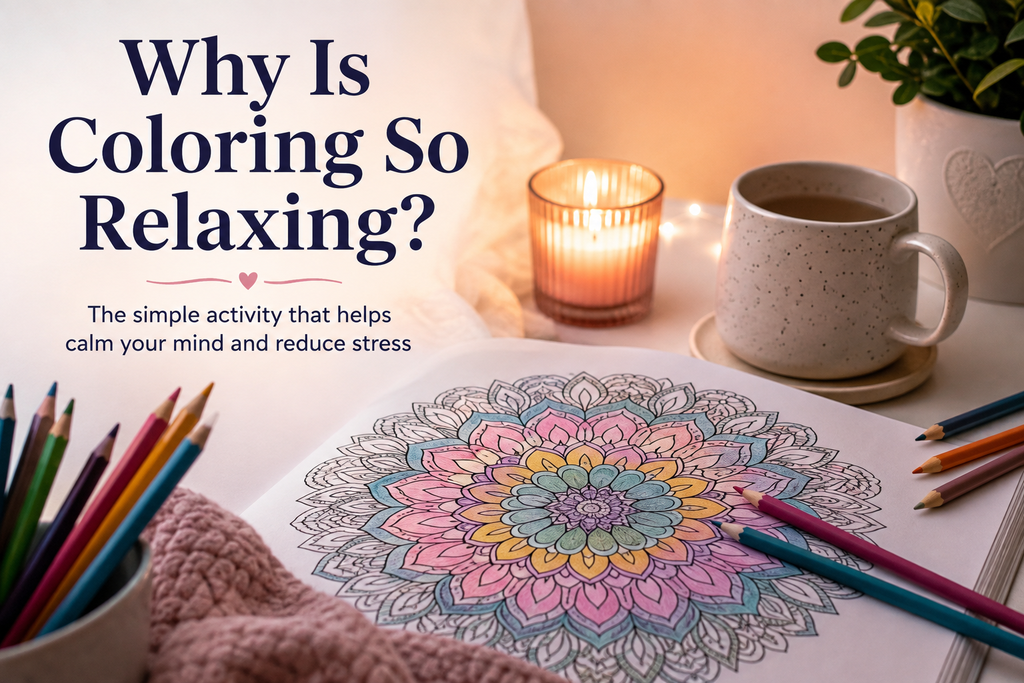
For some people, coloring becomes a small personal ritual: a cup of tea, a comfortable chair, some soft lighting, and 10 or 15 minutes with a coloring page.
The goal isn’t to create a strict routine. It’s simply to create a small moment that feels separate from the rest of the day.
It can also be a pleasant alternative to screens at the end of the day, giving you a chance to step away from notifications and endless scrolling.
For other simple ways to relax, you can also explore these relaxation techniques and activities from Mayo Clinic.
Do You Need to Know How to Draw to Enjoy Adult Coloring?
Not at all — and that’s one of the best things about coloring for adults.
Coloring isn’t about artistic talent. The drawing is already there; you simply add the colors.
There is no intimidating blank page and no pressure to be “good at art.” What matters is the experience of coloring, not creating a perfect finished picture.
That’s also why printable coloring pages are so convenient.
You can choose a design that matches your mood, print it in just a few minutes, and start coloring with nothing more than a few colored pencils or markers.
If you’re just starting out, our guide to coloring tips for beginners can help you get comfortable with basic techniques.
How to Get Started With Coloring for Relaxation
Getting started is easier than you might think.
- Choose a coloring page you like. Pick a design that catches your attention. It can be simple or detailed — there is no right choice.
- Gather a few colored pencils or markers. You don’t need a huge collection. Five or six colors are more than enough to begin.
- Make yourself comfortable. A comfortable chair, good lighting, and a quiet moment can make the experience more enjoyable.
- Don’t worry about perfection. Going outside the lines a little is completely fine. This isn’t a test.
- Give yourself 15 to 30 minutes. You may find that even a short coloring session gives you a welcome break from a busy day.
What Kind of Coloring Pages Are Best for Relaxation?
Different designs can create different experiences. The best choice depends on what you feel like coloring at the moment.
- Mandala coloring pages — Repetitive, symmetrical patterns that provide a clear structure while leaving plenty of room for creative color choices.
- Floral coloring pages — Flowers, leaves, and nature-inspired designs with soft, organic shapes.
- Animal coloring pages — Fun and detailed designs for anyone who enjoys bringing animals to life with color.
- Cozy coloring pages — Warm interiors, candles, mugs, books, and other comforting scenes that are especially enjoyable in the evening.
- Simple coloring pages — Great for a short coloring session when you want something easy and uncomplicated.
Mandala coloring pages — Repetitive, symmetrical patterns that provide a clear structure while leaving plenty of room for creative color choices. Research has also explored the potential calming effects of mandala coloring in adults. Read the study on PubMed
Try a Free Coloring Page
Ready to give it a try?
Explore Mila Pastel’s free printable coloring pages, choose a design that catches your eye, and give yourself a few quiet minutes to color.
Sources & Further Reading
If you want to give readers access to the research behind the article, I would add a small Sources & Further Reading section at the end rather than scattering too many external links throughout the text:
Can Coloring Mandalas Reduce Anxiety? — Art Therapy — Nancy A. Curry & Tim Kasser.